
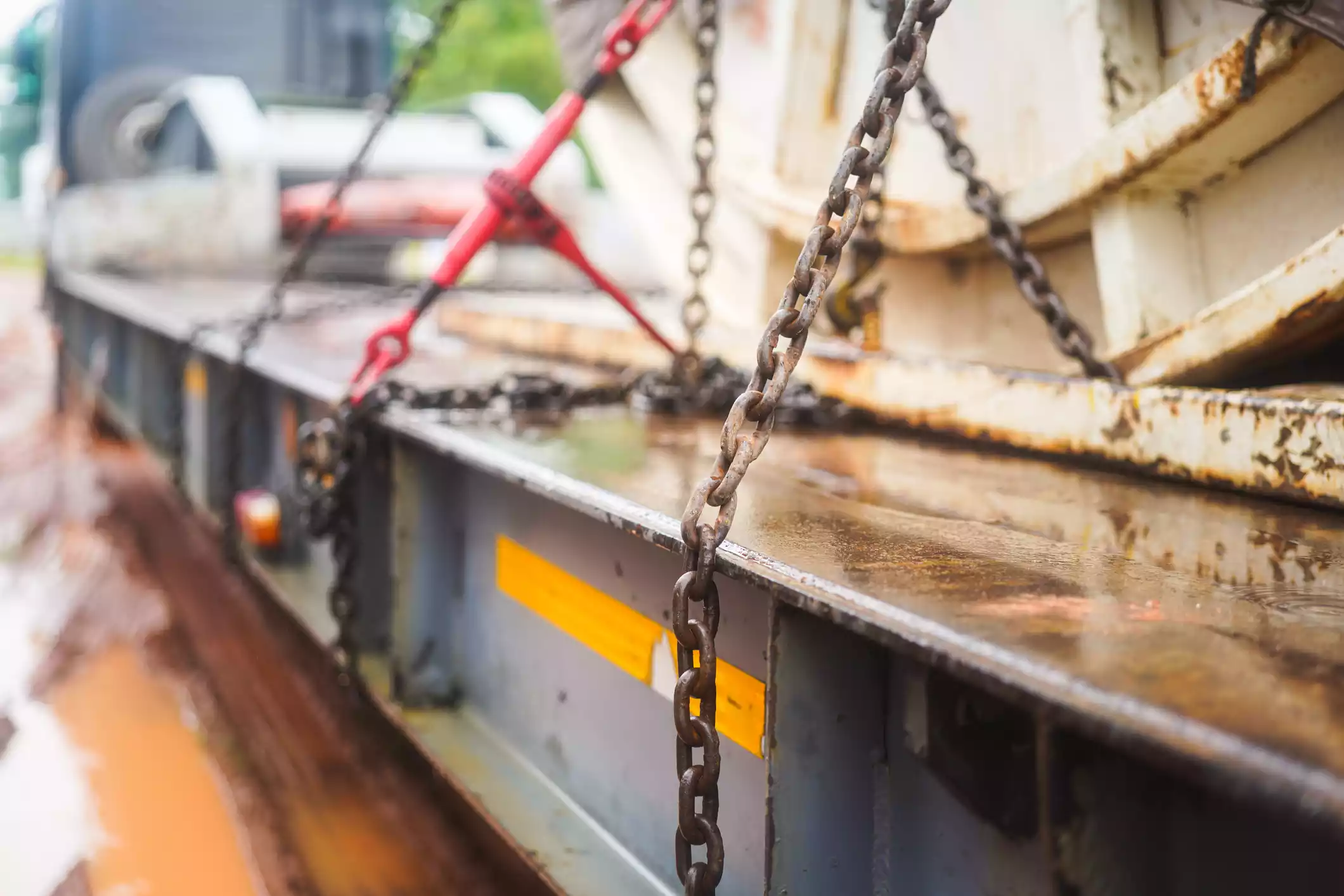
All transport chains aren’t created equal and substituting one kind for another can lead to chain failure, damage to cargo and fines for compliance violations. Knowing the regulations, choosing the right transport chains and installing those chains correctly are critical.
First: The Rules
According to Federal Motor Carrier Safety Administration (FMCSA), all cargo securement systems must meet the general requirements, with commodity-specific requirements taking precedence over the general rules. (Information about commodity-specific securement requirements can be found here.)
FMCSA requires that cargo securement systems—which includes blocking and bracing, tie-downs, and dunnage bags—be capable of withstanding the forces associated with the following three deceleration/accelerations, applied separately:
- 8 g deceleration in the forward direction
- 5 g acceleration in the rearward direction
- 5 g acceleration in a lateral direction
Or to make it simpler, here’s a summary from The Ohio State University’s College of Food, Agricultural, and Environmental Sciences regarding the minimum amount of force in each direction that a cargo securement system must be able to withstand:
- Forward Force = 80% of cargo weight when braking while driving straight ahead.
- Rearward Force = 50% of cargo weight when accelerating, shifting gears while climbing a hill, or braking in reverse.
- Sideways Force = 50% of cargo weight when turning, changing lanes, or braking while turning.
Equally important, notes FMCSA, is that the aggregate working load limit (WLL) of the chains must be at least one-half the weight of the article or group of articles.
As for the minimum number of tie-downs, this is based on the length and weight of the articles. For example, you’ll need one tie-down for articles 5 ft or less in length, and 1,100 lbs or less in weight, and two tie-downs if the article is either 5 ft or less in length and more than 1,100 lbs in weight or greater than 5 ft but less than 10 ft, regardless of weight.
Keep in mind that when transporting certain cargo (machinery or fabricated structural items, for example), the rules concerning the minimum number of tie-downs do not apply. However, the cargo must be secured adequately to the vehicle by devices that are capable of meeting the performance requirements and the working load limit requirements.
Go here for details about Canadian regulations for securing cargo from the Canadian Council of Motor Transport Administrators (CCMTA).
Second: The securement points
Next, identify the securement points on the trailer and the cargo. Choosing the correct places to attach the transport chains will keep the cargo securely in place until it reaches its destination.
Generally speaking, says Whip Around (makers of fleet maintenance software and a vehicle inspection app), machinery weighing less than 10,000 lbs requires one tie down in the front and one tie down in the rear. Heavy equipment over 10,000 lbs requires a minimum of four tie-downs to be used on independent corners. Equipment manufacturers usually have specific securement specifications and tie down points.
There are two types of securement points that can be used when hauling heavy equipment: direct securement and indirect securement, notes Wireless Links (a manufacturer of GPS telematics hardware and software products and solutions).
- Direct securement means the tie-downs go directly from the trailer to the equipment.
- Indirect securement refers to tie-downs that go over the equipment and attach to the trailer on both ends.
Either method can be used provided it meets the working load limit requirements.
Third: Transport chain types
Tie-downs include heavy-duty cargo straps, tie-downs, winch straps, chains, bungee cords, and more. Transport chains come in multiple grades, with the most common including Grade 30, Grade 43, Grade 70, Grade 80, Grade 100 and Grade 120. Link sizes range from 1/4” to 5/8”, with larger links are also available.
- Grade 30, also known as proof coil chain, is used for general-purpose applications but is not suitable for overhead lifting.
- Grade 43, or high-test chain, is stronger and often used for binding and logging.
- Grade 70, known as transport chain or trucker’s chain, is widely used in the trucking industry due to its high strength and durability, making it ideal for securing heavy loads.
- Grades 80, 100 and 120 are alloy chains used in rigorous applications, including overhead lifting and heavy-duty tie-downs, with Grade 120 being the strongest and most versatile.
Using a lower grade rated chain on loads above its weight rating can cause it to snap, while a higher-grade chain is more likely to stretch if used under excessive load. Bottom line: any chain can fail when subjected to extreme loads. And when that happens, it can cause severe injury or even death.
Using the right grade chain is the first step to ensuring your load will remain secure. Briargate Supply provides dependable, high-performance cargo control products that will meet your exact needs, whether your load is on flatbeds or inside a trailer or van. Contact us today for more information.